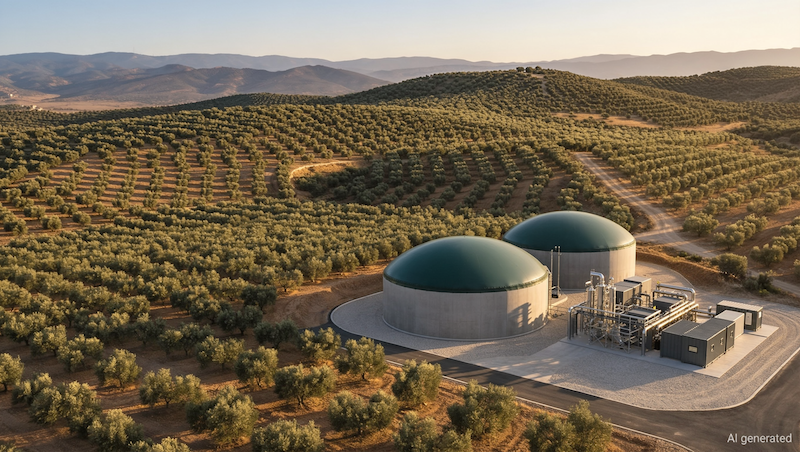
Spain produces more than 50 % of the world's olive oil. Behind that figure lie millions of tonnes of olive pomace (alperujo) generated every year, the solid residue of two-phase oil extraction. For a long time it was a disposal problem rather than an opportunity. Today, under the RED II/III framework and certification schemes such as ISCC EU and REDcert, olive pomace is one of the substrates with the greatest potential for certified biomethane production in Andalusia, Castilla-La Mancha and Extremadura. One caveat: certification requires that the substrate appears on the scheme's list of eligible feedstocks and that its classification as waste or residue is recognised by the target Member State. This should be verified with the certification body upfront.
The timing could hardly be better. The Transport Decarbonisation Observatory, prepared by PwC for Gasnam and presented at the Green Gas Mobility Summit 2026 (#GGMS26), puts the number of biomethane plants Spain will need by 2040 to meet European transport emission-reduction targets at 278 [1]. Olive pomace is abundant, currently under-used and can be classified favourably under RED III. That makes it part of the answer.
What olive pomace is and why it matters for biomethane
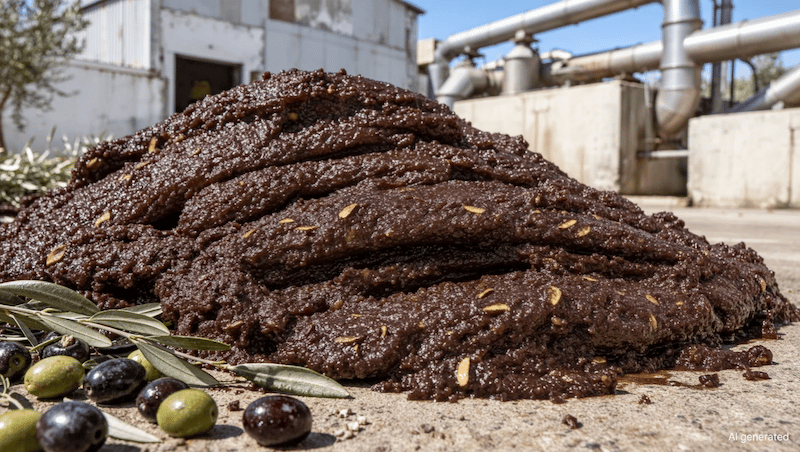
Olive pomace is the semi-solid residue left after olives are centrifuged in two-phase mills, the dominant system in Spain. It consists of skin and pulp, pit fragments, vegetation water and a residual oil content of roughly 3 to 8 % by weight, depending on fruit ripeness and extraction efficiency.
Spain generates between 4 and 6 million tonnes of olive pomace per season, with strong geographic concentration: Jaén, Córdoba and other Andalusian provinces account for more than 70 % of national output. Seasonality is pronounced. Virtually the entire volume is generated between October and December, which directly shapes the operational design of any plant using it as a primary substrate.
From an energy standpoint, anaerobic digestion studies on olive pomace report yields of 60 to 100 Nm³ of biogas per tonne of fresh matter, with a methane content of 50 to 65 %. That is comparable to co-substrates such as maize silage (90 to 120 Nm³/t) and significantly higher than liquid manure (20 to 30 Nm³/t). Because of its inhibitory compounds, however, olive pomace requires substrate-specific technical design.
The demand this biomethane would serve is already real. #GGMS26 highlighted that major shippers such as Alimerka, Eroski and Pascual are building bio-LNG into their sustainability strategies, and long-haul operators are generating growing demand for certified biomethane that domestic production cannot yet fully meet [2].
Classification under RED II/RED III: waste, residue and the consequences for the GHG balance
Classifying olive pomace under the Renewable Energy Directive (RED II, Directive (EU) 2018/2001) is far from straightforward, and it directly affects the value of the resulting biomethane. The rules certification schemes apply when verifying sustainability criteria and GHG savings are set out in Implementing Regulation (EU) 2022/996 [5].
Olive pomace arises inevitably during oil extraction and is not produced deliberately for a market. In most cases it can therefore be treated as a processing residue within the meaning of Article 2 of RED II. The final classification, however, depends on the documentation submitted by the operator and the assessment of the certification body. The distinction matters: for wastes and residues, emissions up to the point of collection are counted as zero (eec = 0 g CO₂eq/MJ). This significantly reduces the carbon footprint of the biomethane and makes it easier to meet the GHG savings thresholds of RED II, for example 65 % for biomethane used in transport from installations that started operation from 2021.
A frequent question is whether a credit for soil carbon accumulation (esca, Emissions Savings from Soil Carbon Accumulation) can be claimed. Under RED II, esca is tied to improved agricultural management. Whether and to what extent it can apply at all to a residue-based pathway, for instance through digestate application, has to be clarified case by case with the certification scheme and the certification body. As this directly affects the declared savings and therefore the value of the certificates, specific advice is recommended.
There is also time pressure. The sector is publicly calling for RED III to be transposed into Spanish law, which was still pending at the time of the cited coverage (June 2026). The directive sets increasing quotas for advanced biofuels in transport and sends a clear price signal to the market [3]. Plants that are already certified once transposition is complete will start from a position of advantage.
→ For a detailed breakdown of how a GHG balance is structured and calculated, see our article Structure and Examples of Calculating a GHG Inventory Using the SURE-EU System.
Technical challenges: seasonality, phenolic compounds and co-digestion
Olive pomace presents three technical challenges that need to be solved at the plant design stage, before certification can even be considered.
Inhibition by phenolic compounds
Olive pomace contains polyphenols, tannins and free fatty acids that inhibit methanogenic activity. At high concentrations these compounds can reduce methane yield by 20 to 40 % or even cause process failure. The most efficient solution is not necessarily costly physico-chemical pre-treatment but co-digestion with nitrogen-rich substrates such as slurry or agro-industrial wastewater, which dilute the inhibitory compounds and balance the C/N ratio of the feedstock.
Feedstock seasonality
The olive harvest concentrates the availability of fresh pomace into a window of ten to twelve weeks. A plant relying on olive pomace as its main substrate needs enough storage capacity to feed the digester for the rest of the year. That means investment in silos or storage lagoons and an assessment of how substrate quality changes during storage (secondary fermentation, loss of methane potential).
Residual oil content
Residual oil can cause foaming in the digester and grease build-up in the agitation system. Managing this requires specific pre-treatment or dilution protocols, and the oil content must be declared correctly in the substrate documentation submitted for certification.
ISCC EU and REDcert certification: substrate traceability as the critical point
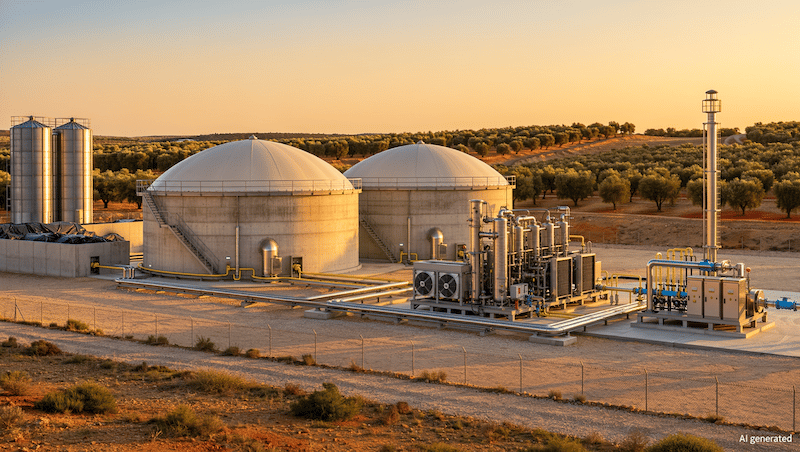
To obtain ISCC EU or REDcert certification for biomethane produced from olive pomace, a plant must demonstrate full traceability from the origin of the substrate to the point of grid injection or delivery.
This includes:
- Documented supply contracts with the originating mills, including the classification of olive pomace as a residue and confirmation that no alternative use would call that classification into question.
- An audited mass balance in line with the requirements of the chosen scheme, recording quantities received, intake dates and storage conditions.
- Declaration of residual oil content and its treatment, since this parameter affects both process performance and the correct assignment of emission values.
- Registration in Nabisy (for the German GHG quota) or in the European Commission's Union Database (UDB), where the target market requires it.
The documentary chain must be in place from the very first day of certifiable production, as it cannot be reconstructed retroactively. The sector itself acknowledges in forums such as #GGMS26 that the main bottleneck to market growth is no longer technological or commercial but administrative [4]. Preparing certification documentation in advance is therefore not just a requirement but a direct competitive advantage over plants that start without it.
How agriportance supports plants using olive pomace
agriportance supports biomethane plants across Europe with GHG accounting and sustainability certification, and assists operators using olive pomace at every stage: from building the initial GHG balance with correct substrate classification and the relevant emission values under Implementing Regulation (EU) 2022/996, through preparing ISCC EU or REDcert audit documentation, to managing certificates on our platform.
Experience with high-phenolic, highly seasonal substrates makes it possible to anticipate points of friction with the external auditor and to prepare the evidence well in advance.
→ Background on the value chain: Introduction to the Biomethane Production Value Chain
Conclusion
Olive pomace is a concrete opportunity for Spain's olive sector: a problematic residue becomes certified biomethane with high GHG savings. Spain needs to scale up biomethane production quickly (the PwC/Gasnam Observatory sets 278 plants as the 2040 target [1]), and agro-industrial substrates such as olive pomace are an essential part of that equation. The keys are correct classification under RED II/III, a technical design that manages process inhibitors, and a rigorous documentary chain that supports the certification audit from day one.
Are you producing or planning to produce biomethane from olive pomace?
Talk to our ISCC EU certification experts.
Get in touch
Sources
[1] Naucher / Gasnam: "Spain will need 278 biomethane plants by 2040 to decarbonise transport." Transport Decarbonisation Observatory (PwC for Gasnam). Presented at the Green Gas Mobility Summit (#GGMS26), Madrid, 17 June 2026. naucher.com
[2] Autónomos en Ruta: "Biomethane and road transport: the sector calls for faster plant permitting to meet demand." #GGMS26, June 2026. autonomosenruta.com
[3] Energy News: "Spain's biomethane sector: a mature technology with production constraints." #GGMS26, June 2026. energynews.es
[4] IndustriAmbiente: "Biomethane is already decarbonising road transport, and the sector calls for faster plant permitting to scale up production." #GGMS26, 19 June 2026. industriambiente.com
[5] European Commission: Commission Implementing Regulation (EU) 2022/996 of 14 June 2022 on rules to verify sustainability and greenhouse gas emissions saving criteria and low indirect land-use change-risk criteria. EUR-Lex.
[6] ISCC System: ISCC EU 205 Greenhouse Gas Emissions, v4.1 (January 2024). iscc-system.org