

Why the German biomethane market is so interesting: an in-depth analysis
The biomethane market has caused quite a stir in recent months. With rapid price jumps, intense discussions about the greenhouse gas (GHG) quota as part of the Renewable Energy Directive (RED) III and a general upturn in the industry due to the energy crisis, it is clear that the German biomethane market is more exciting than ever. But what makes it so attractive? And what conditions characterise the German market in particular?
A dynamic market picture: biomethane revenue through the greenhouse gas quota
According to dena's „Biomethane industry barometer 2023“ analysis, total biomethane sales exceeded the 11 TWh mark for the first time in 2022. One of the main drivers of this development is the growing demand for biomethane in the fuel sector. Increased import and export activities are also seen here. A particular incentive for EU member states is that biomethane produced in other EU countries can be counted towards the German greenhouse gas quota (GHG quota).
What are the advantages of the German greenhouse gas (GHG) quota?
The greenhouse gas quota (GHG quota) in Germany characterises the legally prescribed reduction of greenhouse gas emissions. Those obliged to fulfil the quota - usually mineral oil companies - must do so by introducing sustainable biofuels to the market. The reference value for the reduction is the reference value for diesel at 94.1 g CO2 equivalent per megajoule. Instead of focussing solely on the energy content of the biofuels provided, as was previously the case with the biofuel quota, the focus is now on the actual reduction of greenhouse gas emissions.
This reorientation arose from the need to steer the use of biofuels more strongly in the direction of reducing greenhouse gas emissions. In 2015, the GHG quota thus replaced the biofuel quota. With this innovation, the German Bundestag is limiting emissions from the petroleum industry. In addition to the direct blending of biofuels, trading in quotas based on the production of biomethane gives oil companies another option for reducing their CO2 emissions.
Biomethane producers play a key role here. They produce the gas, which serves as a fuel and thus indirectly saves CO2 emissions. The resulting GHG quota is either sold directly to the obligated companies if the producers also act as distributors of the biomethane, or they sell the biomethane to other distributors. The placing on the market or refuelling of the biomethane generates the quota in question. The revenue generated is based on the sale of these quotas to the obligated companies.
This switch from the biofuel quota to the GHG quota is based on the European Renewable Energy Directive (RED II). The original Renewable Energy Directive (RED) from 2009 and its revision from 2018 (RED II) set the targets for renewable energies in the transport sector. These define criteria for sustainability and greenhouse gas savings. At the same time, the Fuel Quality Directive (FQD) was established, which aims to reduce the life cycle emissions of fuels. EU member states are obliged to transpose these directives into national law. In Germany, this resulted in the integration into the Federal Immission Control Act (BImSchG) and the Biofuel Sustainability Ordinance (Biokraft-NachV).
What conditions make Germany an attractive biomethane market?
The GHG quota in Germany was introduced to incentivise the market, particularly for biofuels with high GHG reduction. While fossil natural gas cannot contribute to the fulfilment of this quota, biomethane offers this possibility. Interestingly, the eligibility of biomethane for this quota depends on the substrate used. A prominent candidate in this area is biomethane produced from manure, such as slurry. This is categorised as an advanced biofuel.
Companies that overfulfil their quota obligation even benefit twice, as surpluses of advanced biofuels can be counted twice towards the general GHG quota. In contrast, companies that do not fulfil or fail to fulfil their quota face financial penalties. These penalties were set at €0.47 per kg CO2eq until the commitment year 2021 and were increased to €0.60 per kg CO2eq from 2022.
These regulations have led to increased demand for biomethane, which in turn has influenced the prices and revenue potential for biomethane in Germany. However, the requirements and therefore also the revenue potential for biomethane vary depending on the substrate group used. The EU has recognised that the production of conventional biofuels can have negative effects, for example by damaging areas with high biodiversity. For this reason, the EU member states have been given guidelines that promote the use of biofuels, but under strict sustainability criteria.
Why is biomethane from farm fertilisers so important for the German biomethane market? Fuele so attractive?
Particular attention is being paid to biomethane from manure, whereby the “manure bonus” must be taken into account. This bonus results in a GHG emission reduction of an impressive standard value of -100 g CO2 eq/MJ, as stipulated in RED II. In fact, this value can even be exceeded if calculated individually. The prices and revenue opportunities for biomethane in Germany are therefore closely linked to the substrate used and the associated GHG quota.
Within the greenhouse gas quota (GHG quota) system, manure and advanced residues will enjoy double crediting in the coming years. This gives them a more favourable GHG value compared to renewable raw materials (NawaRos). For you, this means that biomethane produced from manure and advanced residues offers the highest revenue opportunities. The reason for this is that the GHG value is the central element in pricing and different premiums or discounts are applied to the price depending on which substrate is used.
What is the price trend for biomethane?
The long-term marketing of biomethane opens up considerable revenue prospects, especially when you consider that a stable and sustainable source of income can be generated by concluding 7-year supply contracts with biomethane customers. Detailed insights into the specific revenue opportunities depending on the substrate used can be found on the website: Find out more about biomethane prices and revenue opportunities here.
However, it is equally important to keep your eyes open for short-term opportunities - this is where the spot market plays a crucial role. On this market, natural gas and electricity are traded almost in real time, allowing supply and demand to meet directly. The transactions carried out here reflect the current market price and are concluded within two days. Trading in biomethane is therefore based on the current exchange price, which harbours lucrative opportunities for higher revenues.
However, one should not focus solely on price trends. Global trends with regard to the need and demand for biomethane are also relevant. Growing media interest in bio-LNG and also bio-CNG is evidence of increasing awareness and interest in sustainable energy sources. In addition, the production of biomethane opens up new business opportunities for biogas plant operators that go beyond the scope of the EEG. It is therefore an exciting time for all those who want to get involved in the biomethane sector.
So what are the key factors for revenue on the German biomethane market?
The key factors on the biomethane market can therefore be summarised as follows:
- The GHG quota: It ensures that companies favour advanced biofuels, which increases biomethane prices in Germany and the associated revenue opportunities.
- Differentiated substrate categories: Depending on the substrates used, biomethane can be credited differently. Biomethane from manure and advanced residues offers the best revenue opportunities, as the GHG value is the price-forming element.
- Long-term marketing opportunities: Biogas producers can secure stable sources of income with 7-year supply contracts.
- The spot market: A look at the spot market shows that biomethane is traded at the current exchange price, which offers additional revenue opportunities.
In addition to the domestic biomethane market, international trade also plays an important role. The growing interest in bio-LNG and bio-CNG also offers new opportunities for biogas plant operators in other EU member states.
What does the international trade in biomethane look like? Keyword: Demand and demand
Demand and interest in the biomethane market have grown significantly as a result of the energy crisis and the resulting rise in natural gas prices. Caused by high gas prices and mechanisms such as the EU Emissions Trading System (EU ETS) and the Federal Emissions Trading Act (BEHG), international trade in biomethane has risen sharply. Data from dena from 2022 shows that 3.5 TWh of biomethane certificates of origin were transferred from neighbouring European countries to Germany. One of the reasons for this is that biomethane - whether as bio-CNG or BIO-LNG - from other EU countries makes a positive contribution to the German GHG quota.
Sources of supply for biomethane have expanded
The range of supply sources for biomethane has therefore expanded. Exports from countries such as Poland, the Czech Republic, Spain and France are particularly relevant here. France is expected to start exporting guarantees of origin from January 2024, which will bring additional quantities of biomethane onto the market. Denmark is also a key player. Biogas already accounts for 30 per cent of the total gas market there. Until now, this biogas has primarily been utilised in Sweden. However, a recent judgement by the European Court of Justice could affect this export route, opening up new opportunities for countries such as Germany.
The outlook for the European biomethane market is positive. More stable markets are emerging as a result of planned biomethane plants and measures at EU level, in particular the RED III Directive. In addition, the establishment of a European Union database will promote trade between EU member states.
However, there are also hurdles. The different sustainability criteria of the EU member states and the associated bureaucratic hurdles make international trade more difficult. For Germany, one thing is clear: only biofuels that meet the criteria of the Biofuel Sustainability Regulation (Biokraft-NachV) can contribute to quota fulfilment.
What are the current regulations for the certification of biomethane in the German fuel market?
Before the first financial returns from quota trading can be realised, there is an essential hurdle to overcome: the certification of the biomethane. Even if biomethane is imported from countries outside the EU, this should not be seen as an obstacle. However, this imported biomethane must meet the same high sustainability standards that apply to biomethane produced in Germany. For Germany, these requirements are specifically set out in the Biofuel Sustainability Ordinance (Biokraft-NachV). Accordingly, biomethane that is used in the fuel sector is either produced by systems such as REDcert or ISCC certified.
The certification process itself is not trivial. The plant operator must appoint a qualified auditor who checks fulfilment of the sustainability criteria in an in-depth audit. This includes, among other things, checking the greenhouse gas reduction through a corresponding GHG balance, a precise analysis of the mass balance and a comprehensive review of all relevant documents that accompany the entire biomethane value chain.
What is the mass balancing of biofuels in the German biomethane market all about?
There are two main guarantee systems for biomethane in the EU member states: the “book and claim” via Guarantee of Origin (GOs) systems and the mass balance system.
While GOs separate the sustainability attributes from the physical product, the mass balance system ensures that certified material leaving a supply chain has been added to it in the same quantity. This system requires detailed records of biomethane transport, biomethane conversion processes and other factors.
In principle, the GO has been extended to cover not only electricity from renewable energy sources, but also renewable gases. The GOs serve as a means of proving to the end consumer that a certain proportion of the energy they consume comes from renewable resources. The GO can be transferred independently of the energy-related gas unit for which it was originally issued For more information on GOs, see Article 19 of RED II or the German Federal Environment Agency. However, a GO issued for biomethane does not contribute to the fulfilment of national renewable energy targets. For this reason, the EU has divided biomethane into two groups with two different potential values as part of RED II:
- A renewable fuel for transport under the mass balance system, with a GHG reduction value for achieving the targets set out in Article 29 (1), and
- green added value for energy products under the GO scheme.
EU mass balance system mandatory for the use of biomethane as a fuel
The different potential values also make it clear that the mass balance system is mandatory on the part of the EU for the use of biomethane as a transport fuel. In Germany, the obligation for mass balancing is explicitly mentioned in the Biofuel Sustainability Ordinance. In this way, they ensure that the amount of certified material that leaves the supply chain corresponds to the amount of certified material that has entered the supply chain, taking into account conversion processes. You can find more information on mass balancing at >Link<
In principle, national regulatory authorities can introduce their own mass balancing systems by having them validated by the EU. The European Renewable Gas Registry (ERGAR) has currently applied for such validation for the European gas grid. The outcome of this application is still open.
What happens after the biomethane is certified?
Once certification has been successfully completed, the operator of biomethane plants can open an account in the Sustainable Biomass System (Nabisy) at the Federal Office for Agriculture and Food (BLE). The newly obtained certificate and the respective quantities of certified biomethane are stored there. In addition, the specific greenhouse gas emissions of the biofuel in kilograms of carbon dioxide equivalent per megajoule must be recorded. Once the data has been entered, the operator is issued with an official sustainability certificate. This document must be submitted to the biofuel quota office together with the annual quota application. You can see what a sustainability certificate looks like in the following illustration. The certificate clearly shows the importance of the mass balance system for participation in the German biomethane market and the relevance of specific greenhouse gas emissions.

Figure 1: Example of proof of sustainability
With regard to the quality of the biofuel, further proof is required, often in the form of certificates of analysis or manufacturer declarations. With the approval of the biofuel quota office, alternative suitable forms of proof can also be accepted. From 1 January 2017, the proof of sustainability or the partial proof in accordance with the Biofuel Sustainability Ordinance (Biokraft-NachV) will be considered formal manufacturer declarations. It should be noted that the biofuel quota office can also require samples that must comply with certain minimum standards. These standards are set out in the standard DIN EN 16723-2:2017-10, which describes the specifications for natural gas and biomethane in the transport sector and for biomethane for feeding into the natural gas grid.
To summarise, both strict certification processes and extensive documentation obligations are required for the trade and use of biomethane in Germany. This ensures that the biomethane fulfils the high requirements for sustainability and quality.
What are the exact biomethane export regulations?
The export of biomethane to Germany is a regulated undertaking that is characterised by a complex legal situation. In principle, the import of gaseous biomethane from other EU member states into the German public natural gas grid is permitted, provided that all relevant requirements are met. The focus here is on the fact that both the feed-in and the withdrawal or exit of the biomethane take place in the excise duty territory of the European Union. It should also be noted that the accounting allocation of biomethane in accordance with the EU directives is limited exclusively to the excise tax territory of the European Union.
What laws and regulations apply to the import of biomethane into Germany
A key criterion here is that the imported biomethane is used as a fuel on the German market. It must also be ensured that the biomass used to produce the biomethane qualifies for offsetting. Correct taxation is another fundamental condition for counting biomethane towards the greenhouse gas (GHG) quota in Germany. It is not only biomethane from other EU countries that can be counted, but also physical biofuel that is physically imported into Germany, regardless of where it is produced, can contribute to the fulfilment of the GHG quota.
Biomethane exported from countries outside the EU, so-called third countries, is subject to a separate regulation. In this case, the biomethane must be in physical form; an accounting allocation is not permitted in this context. If you are considering biomethane products, whether in gaseous form (bio-CNG) or in liquefied form (bio-LNG), from other EU countries, you should find out about the specific requirements. The main customs office provides detailed information for the biomethane market on the conditions that must be met in order for such products to be counted towards the German GHG quota. For a more comprehensive and clear overview, these criteria are detailed in the figure below.
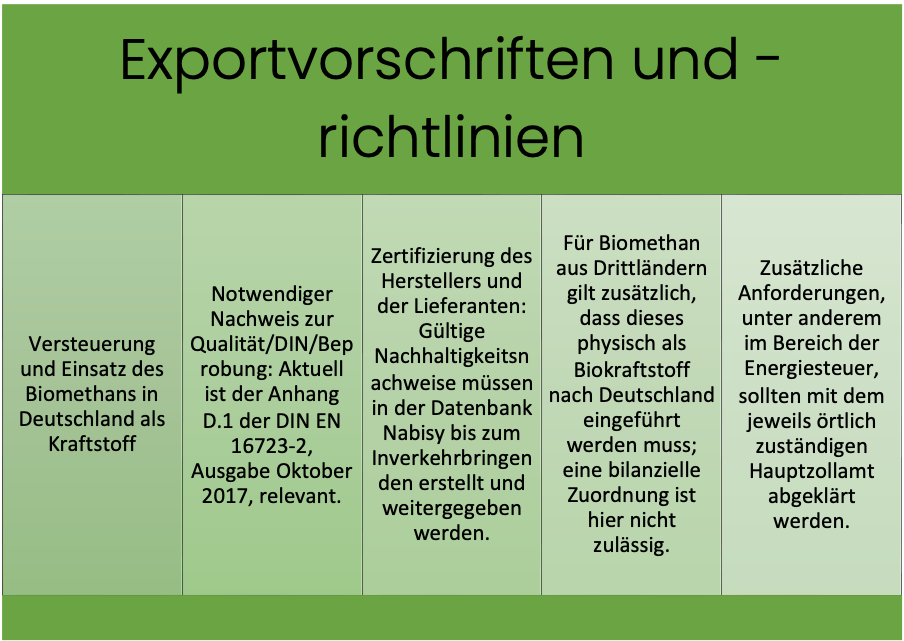
Figure 2: Export regulations and guidelines for biomethane imports
If you require further information, you can find it on the website of the main customs office under the keyword “greenhouse gas quota” or you can contact us.
The international trade opportunities for biomethane between Germany and other countries - whether EU member states or third countries - vary depending on the existing legal regulations and bilateral agreements.
What are the possibilities for international trade in biomethane between Germany and other EU member states or non-EU member states?
Within the EU: Biomethane trading with EU member states is possible under certain conditions and in compliance with sustainability requirements. This allows the free trade of biomethane via the public natural gas grid. It must be ensured that imported biomethane fulfils the same sustainability requirements as biomethane produced in Germany and that the above-mentioned export regulations and guidelines are complied with.
Non-EU member states - case of Switzerland: Although Switzerland is not a member of the EU, it has numerous agreements with the EU that facilitate trade. However, there are special provisions and regulations that must be observed when exporting biomethane from Switzerland to Germany.
Austria and its special features: Austria has its own system for regulating biomethane and its trading on the biomethane market. In Austria, if the producer feeds gas into the public grid and it is not withdrawn elsewhere either for final consumption or for conversion purposes, e.g. if gas is used for the transport sector, the gas certificate of origin (HKN) pursuant to §81 of the Renewable Energies Expansion Act Package (EAG) applies. In concrete terms, this means that when gas is converted, the guarantee of origin is cancelled and green gas certificates are issued instead in accordance with Section 86 EAG (exception UBA). This means that the guarantees of origin cannot be removed. E-Control is the independent electricity and gas regulatory authority in Austria that monitors and supervises the energy markets. In concrete terms, however, you should first remember that biomethane exports from Austria do not take place without further ado and that many individual regulations must be considered
It is important to emphasise that, despite the possibility of trading biomethane at international level, compliance with sustainability criteria, legal requirements and bilateral agreements must always be guaranteed.
The German biomethane market - an outlook
The German biomethane market is at the centre of a dynamic development driven by regulatory incentives, market mechanisms and international trends. It therefore offers players a wide range of opportunities with regard to biomethane exports to Germany and revenue opportunities on the German fuel biomethane market. To help you overcome the challenges of certification for biomethane exports to Germany, simply get in touch with us.
 Deutsch
  English (UK)
  Français
  Italiano
  Español
  Polski
  Svenska
  Dansk
Dansk  Nederlands (België)
  Português
  Čeština